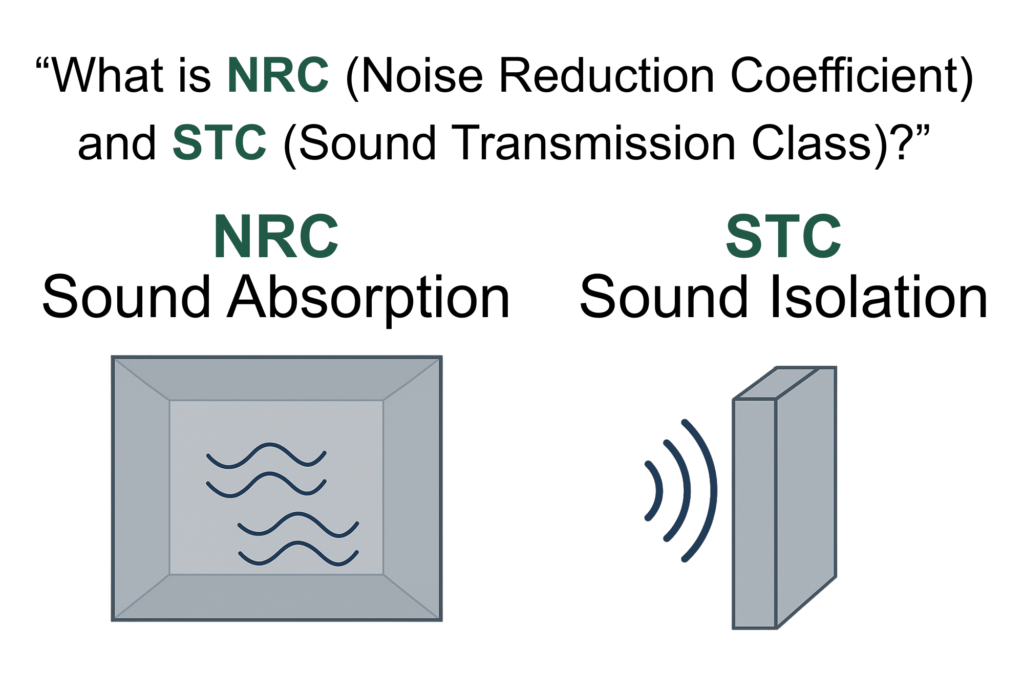
What is NRC and STC? In modern building construction, especially when specifying high-performance insulated panels like those offered by McMillan Insulated Panels, acoustic performance is increasingly important. Whether you are working on commercial office space, hospitality, multi-unit residential, or industrial facilities that require both thermal and acoustic control, two key metrics often surface: NRC (Noise Reduction Coefficient) and STC (Sound Transmission Class). While they might sound similar at first glance, they measure fundamentally different acoustic behaviours.
In this blog post we’ll explore:
• What NRC and STC are, in technical and practical terms
• How each rating is measured
• Why they matter for building design and insulated panels
• How to interpret the values and make informed decisions
• Some pitfalls and limitations to be aware of
• How McMillan’s insulated panel solutions relate to these ratings
Let’s begin by defining each.
What is NRC (Noise Reduction Coefficient)?
Technical Definition
The Noise Reduction Coefficient (NRC) is essentially a single-number rating that represents how much sound a material absorbs (rather than reflects) when that sound hits the surface. In simple terms: when sound energy strikes a surface, how much of it is “soaked up” by the material vs how much bounces back into the room.
More precisely, NRC is defined (in one common standard) as the arithmetic average of the sound absorption coefficients of a material at four one-third-octave frequency bands: 250 Hz, 500 Hz, 1000 Hz, and 2000 Hz. The result is then rounded (commonly to the nearest 0.05).It is typically expressed in a scale from 0.0 to 1.0 (or occasionally slightly above 1.0 under laboratory anomalies) where:
• NRC = 0.0 means the material virtually absorbs no sound at those test frequencies (i.e., nearly all sound is reflected)
• NRC = 1.0 means the material behaves (in those test frequencies) as if it absorbs 100% of the incident sound energy (or practically, a very high absorption)
However, real-world values rarely hit exactly 1.0 for typical building materials.
Practical Meaning
From a design and building specification perspective, a high NRC rating means the material is effective at reducing echo, reverberation, and overall ambient noise within a space. For example: large open offices, cafeterias, gymnasia, classrooms, or any large room with hard surfaces may suffer from excessive reverberation. Specifying wall or ceiling panels with a good NRC helps make the space more acoustically comfortable and intelligible (better speech clarity, less “live” sound reflections).
On the flip side, a low NRC material (such as plain painted concrete, glass, or bare metal) will reflect much of the sound, making the room “live”, echoey, and acoustically uncomfortable.
What Values to Expect
Here are some typical benchmark ranges (for NRC) to give a sense of what the number means:
• NRC 0.0 – 0.2: Very little absorption, mostly hard reflective surfaces (e.g., painted concrete, bare plaster)
• NRC 0.3 – 0.6: Moderate absorption (e.g., carpets plus underlay, standard acoustic ceiling tiles)
• NRC 0.7 – 1.0: High absorption (e.g., dedicated acoustic panels, thick fabric-wrapped panels, special acoustic treatments)
In short: higher = better absorption (for reducing reflection) in your space.
How It’s Measured & What Affects It
Testing is typically done in a reverberation chamber (an acoustically-controlled room) per standards such as ASTM C423. The process typically involves measuring how long it takes for a sound to decay in the test room without the sample, then with the sample installed, calculating the absorption difference, dividing by sample area, and converting to absorption coefficient. Then average the coefficients at the test frequencies to yield NRC.
Key factors influencing NRC include:
• Material porosity, thickness, density and surface finish
• Mounting method and position (for example, panels mounted with an air space behind them may perform differently)
• The frequency spectrum of the incident sound (note: NRC uses mid-frequencies only)
• Room geometry and background absorption (in field, not just lab)
Limitations to Keep in Mind
• The NRC rating focuses on specific mid frequencies (250-2000 Hz), so it may not fully capture absorption behaviour at very low (<250 Hz) or very high (>2000 Hz) frequencies. Medium
• Since it is an average, it may mask poor absorption at critical frequencies for your use case (for example, low-frequency rumble, machinery noise)
• It speaks only to absorption (internal room acoustics) and not to transmission of sound through the material (i.e., what happens on the other side)
What is STC (Sound Transmission Class)?
Technical Definition
The Sound Transmission Class (STC) is a single-number rating that indicates how well a building partition (wall, ceiling, door, floor) attenuates airborne sound transmission from one side to the other. In plain terms: when sound is generated on one side of the partition, how much of it gets through to the other side.
The STC rating is derived from laboratory measurements of the Transmission Loss (TL) of the partition at a series of standard one-third octave frequency bands from about 125 Hz up to 4000 Hz. The TL values are plotted and compared against standard STC contour curves (per ASTM E413) to determine the STC value
In essence: higher STC = better sound isolation (less sound gets through).
Practical Meaning
When you’re concerned about noise moving between rooms—such as in apartment walls, hotel rooms, office boardrooms, or any multi-unit construction—STC is the go-to metric. A wall with a high STC rating will do a better job of preventing speech, loud sound or music from one side being heard on the other side. Consider:
• In a residential context: You might specify an STC ≥ 50 for shared walls so that conversations in one unit aren’t intelligible in the next. Acoustical Surfaces+1
• In a recording studio: You’d target STC values even higher (or different acoustic metrics entirely) because low frequency and structure-borne sound becomes significant.
• In industrial or hospitality settings: Beyond just STC, you often need to consider low frequency rubber‐shell, decoupling, mass, etc. Soundproofing Company
What Values to Expect
Some typical STC guidelines: Acoustical
• STC 25-30: Poor sound isolation — conversations easily heard, thin partitions
• STC 35-40: Moderate — speech audible, but may lose intelligibility
• STC 45-50: Good — conversations likely not intelligible, substantial sound reduction
• STC 55-60 and above: Excellent — strong sound isolation, good for demanding privacy or noise control
How It’s Measured & What Affects It
• Testing per ASTM E90 uses a source room and receiving room separated by the test partition; sound levels at multiple frequencies are measured, TL is computed, and a standard curve is used to derive STC. Acoustical Surfaces+1
• Important factors in STC performance: mass of the partition, stiffness (rigidity), air gaps or leakage, insulation in cavities, decoupling the faces, and how flanking paths (sound around/through adjacent structures) are dealt with.
What is STC (Sound Transmission Class)?
Technical Definition
The Sound Transmission Class (STC) is a single-number rating that indicates how well a building partition (wall, ceiling, door, floor) attenuates airborne sound transmission from one side to the other. In plain terms: when sound is generated on one side of the partition, how much of it gets through to the other side.
The STC rating is derived from laboratory measurements of the Transmission Loss (TL) of the partition at a series of standard one-third octave frequency bands from about 125 Hz up to 4000 Hz. The TL values are plotted and compared against standard STC contour curves (per ASTM E413) to determine the STC value.
In essence: higher STC = better sound isolation (less sound gets through).
Practical Meaning
When you’re concerned about noise moving between rooms—such as in apartment walls, hotel rooms, office boardrooms, or any multi-unit construction—STC is the go-to metric. A wall with a high STC rating will do a better job of preventing speech, loud sound or music from one side being heard on the other side. Consider:
• In a residential context: You might specify an STC ≥ 50 for shared walls so that conversations in one unit aren’t intelligible in the next.
• In a recording studio: You’d target STC values even higher (or different acoustic metrics entirely) because low frequency and structure-borne sound becomes significant.
• In industrial or hospitality settings: Beyond just STC, you often need to consider low frequency rubber‐shell, decoupling, mass, etc.
What Values to Expect
Some typical STC guidelines:
• STC 25-30: Poor sound isolation — conversations easily heard, thin partitions
• STC 35-40: Moderate — speech audible, but may lose intelligibility
• STC 45-50: Good — conversations likely not intelligible, substantial sound reduction
• STC 55-60 and above: Excellent — strong sound isolation, good for demanding privacy or noise control
How It’s Measured & What Affects It
• Testing per ASTM E90 uses a source room and receiving room separated by the test partition; sound levels at multiple frequencies are measured, TL is computed, and a standard curve is used to derive STC.
• Important factors in STC performance: mass of the partition, stiffness (rigidity), air gaps or leakage, insulation in cavities, decoupling the faces, and how flanking paths (sound around/through adjacent structures) are dealt with.
Limitations to Keep in Mind
• STC tends to focus on mid-frequencies (125 Hz upward) and may not fully capture low-frequency noise (bass, heavy machinery, traffic rumble) or vibration-borne sound.
• A high STC number does not guarantee perfect isolation if flanking paths or leaks exist (doors, windows, penetrations)
• It’s a lab-based metric; field performance will vary depending on detailing, construction quality, and adjacent systems.
Whether you’re designing a noise-sensitive commercial space, an industrial facility, or an energy-efficient building that demands both thermal and acoustic performance, our experts at McMillan Insulated Panels are here to help. We’ll guide you in choosing the right panel system with the optimal NRC and STC ratings for your project.
Contact with our experts
📩 info@mcmillaninsulatedpanels.com
🖥️ Contact