In an increasingly urbanized world, where the growth of cities goes hand in hand with the rise of vehicular, rail, and industrial traffic, a crucial challenge arises: the control of noise pollution. Acoustic barriers have become a key solution to mitigate this issue, especially in the modernization of urban infrastructure, where the goal is to improve quality of life without hindering development.
These structures, made from specific materials such as insulating panels, are designed to block, reflect, or absorb noise, significantly reducing the amount of sound transmitted from an emitting source (such as a highway) to residential or sensitive areas (such as hospitals, schools, or urban parks).
Advantages of Integrating Acoustic Barriers in Urban Planning and the Construction Sector
The integration of acoustic barriers in urban design is not only a technical necessity but also part of a trend toward sustainable and smart construction. Here are some of their main advantages:
1. Improved acoustic comfort: By reducing ambient noise, these barriers enhance rest, concentration, and the overall well-being of the population.
2. Increased value of the urban environment: Areas with lower noise pollution are more attractive for living or investment, directly impacting property values.
3. Protection of sensitive infrastructure: School buildings, hospitals, or protected natural areas require a controlled acoustic environment.
4. Adaptability and design: Modern barriers, such as those offered by McMillan Insulated Panels, allow for aesthetic customization that blends with the urban environment without compromising acoustic efficiency.
5. Easy installation and maintenance: Current technology enables modular and lightweight systems that reduce assembly time and long-term maintenance costs.
6. Sound Barriers and Insulated Panels Against Noise Pollution
What is noise pollution? Noise pollution refers to the presence of elevated noise levels in the environment, primarily caused by traffic, industrial activity, and the intensity of urban life. According to the World Health Organization (WHO), environmental noise is one of the major factors affecting public health in urban settings.
How does it affect us? Prolonged and constant noise exposure can have multiple effects:
• Cardiovascular problems and increased stress.
• Sleep disorders and chronic fatigue.
• Concentration difficulties, especially in children.
• Irritability and reduced quality of life.
This type of pollution is particularly serious because it often goes unnoticed until it causes cumulative consequences.
How do sound barriers and insulating panels address this issue?
Acoustic barriers work by interrupting the direct propagation of sound waves. There are several mechanisms of action:
• Absorption: Insulated panels made from porous, high-density materials absorb sound energy.
• Reflection: Noise is redirected in another direction to prevent it from reaching protected areas.
• Attenuation: Thanks to their mass and composition, these barriers significantly reduce noise intensity.
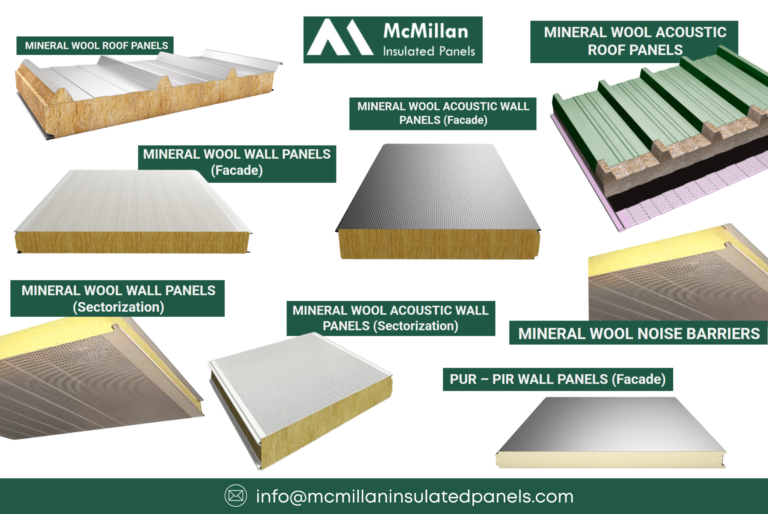
McMillan Insulated Panels’ acoustic panels offer an advanced technical solution with a modular design, high acoustic performance, structural strength, and sustainability. Their application in urban environments enhances comfort, protects public health, and promotes responsible urban planning.
One of the main features of these panels is their mineral wool core, which enhances sound absorption. The system includes tongue-and-groove joints that eliminate acoustic bridges, maximizing both insulation and absorption. They also offer mechanical resistance up to 525 Kg/m², making them lightweight, non-combustible, moisture-resistant, and suitable for various weather conditions—ensuring long-lasting durability.
Installation is Simple Thanks to a Modular Design That Allows for Easy Assembly and Maintenance, Adaptable to Large-Scale Projects Requiring High Levels of Noise Reduction
You can find more information in the Insulated Panels section of our website:
Noise Barriers
Does it offer sustainability benefits?
Yes, acoustic barriers not only combat noise—they also have a positive impact in terms of sustainability:
• Reduced energy use: By thermally insulating certain environments, they contribute to energy savings.
• Recyclable and durable materials: Many modern insulated panels are made from recyclable materials with a long service life.
• Less need for urban intervention: By controlling noise with passive solutions, the need to relocate communities or redesign large urban areas is reduced.
• Contribution to more livable cities: Noise control encourages public transport, outdoor living, and the design of more human-centered urban spaces.
Acoustic Barriers as a Strategic Solution
In a context where cities must grow without sacrificing the well-being of their inhabitants, acoustic barriers emerge as an essential tool. They not only address a current issue—noise pollution—but also help build more sustainable, healthier, and socially responsible environments.
The implementation of insulated panels like those from McMillan Insulated Panels shows that it is possible to combine technical efficiency, urban design, and environmental commitment. Investing in these solutions means investing in quality of life, modern infrastructure, and an urban future where development and comfort can coexist.
Our panels are designed to meet international standards for acoustic insulation, using metal cores and weather-resistant finishes, ensuring performance and durability even in the most demanding conditions.
Join the fight against noise pollution – consult with our experts now:Contact