Choosing Panels: Here are some tips and best practices for using NRC and STC in selecting insulated panels and designing acoustic performance:
1. Clarify the acoustic objective
- Are you trying to make a room more acoustically comfortable (reduce echo)? => focus on NRC
- Are you trying to prevent sound transfer between rooms/zones? => focus on STC
- Often the answer is “both” and you’ll need panels/assemblies that address both.
2. Check the mounting condition and test details
- Manufacturers often provide NRC/absorption data assuming specific mounting types (e.g., flush to wall, with air cavity behind, suspended ceiling) which may differ from your field condition.
- NRC may change with mounting.
- STC values are based on lab conditions; field results may be lower due to flanking, holes, doors, windows. Always check field ratings or in‐situ performance.
3. Look at frequency spectrum if critical
- If your noise source is low-frequency (mechanical equipment, traffic rumble, industrial machines) then standard NRC or STC might not tell the full story—look for data at lower frequencies or alternate metrics (e.g., OITC, Third-Octave Transmission Loss). Soundproofing Company+1
- For rooms focused on speech clarity, the mid-frequencies covered by NRC are highly relevant.
4. Don’t rely on a single number alone
- Both metrics simplify complex acoustic behaviour into a single number. Use them as guides, but also consider room geometry, other surfaces, absorption in adjacent spaces, and sound paths.
- Especially for partition performance, the weakest path dominates: even a high STC panel won’t perform if doors/ducts/windows are unmanaged. auralexchange.com
5. Balance with other design criteria
- Insulated panels bring many performance factors: structural, insulation (thermal), fire rating, acoustic. Specifiers often must make trade-offs.
- For example: A thicker or heavier panel may improve STC/mass but may cost more or have other installation implications. A panel with sound-absorptive facing (for NRC) may need different finish or mounting.
6. For McMillan’s panels consider key acoustic parameters
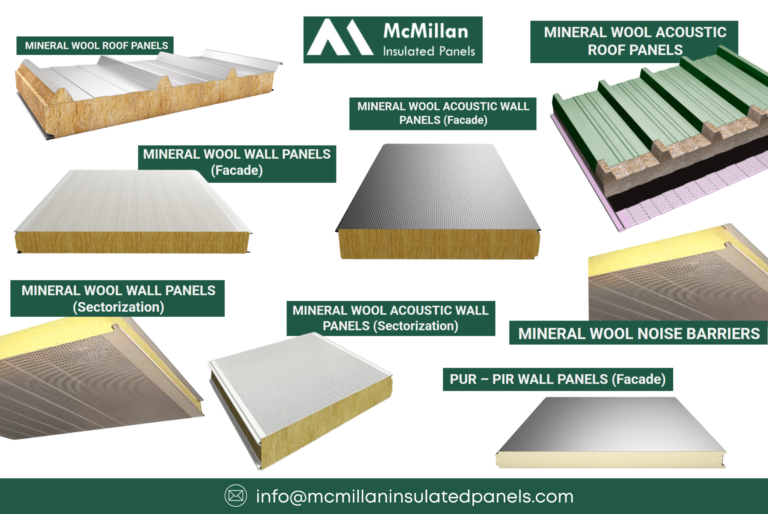
- If McMillan supplies mineral wool core acoustic roof/wall panels (as the site indicates: “Mineral Wool Acoustic Roof Panels”, “Mineral Wool Acoustic Wall Panels (Facade)”) then you can emphasise their acoustic performance: both internal absorption (good NRC) and partition/wall separation or barrier (good STC).
- Provide data sheets or acoustic test certificates so architects/engineers can specify with confidence.
Application Examples & Case Studies
Example 1: Open Office Space
An office floor uses insulated metal panels for interior partition walls (e.g., demising walls) and on the ceiling. The panel surfaces are hard metal and glass. Without acoustic treatment the space is noisy and speech intelligibility suffers.
- You might select wall panels with NRC >= 0.9 to reduce reverberation and improve clarity.
- For the demising wall between separate offices you might specify an assembly with STC >=40 dB so that conversation in one office doesn’t intrude into the next.
- McMillan’s acoustic panel finish versions can help meet both.
Example 2: Multi-Family Residential Building
In multi-family housing, sound privacy between units is essential. A stairwell or corridor might use insulated panels for fire/thermal, but the wall between units needs adequate sound attenuation.
- The designer might require STC 55 or higher on the partition (walls, floor/ceiling) to meet building code or owner requirements.
- If the interior of the unit has a “theatre room” or workout area, then panels with higher NRC might be used for the room finish to reduce reverberation and annoyance.
Example 3: Industrial Warehouse with Office Insert
A large warehouse with metal panel siding is converted to include an office insert. The warehouse has echo and noise from forklifts, and the office needs quiet.
- On the ceiling/roof panels, you might specify acoustic-faced panels with higher NRC to reduce reverberation of machinery noise.
- The office wall that separates the warehouse from the office space might require a panel assembly rated for a higher STC to reduce intrusion of forklift, engine or ambient equipment noise.
Ready to take the next step?
👉 Contact our technical team today to discuss your acoustic requirements or request detailed product specifications. Stay connected with us for more insights, project highlights, and product innovations — follow McMillan Insulated Panels on LinkedIn for the latest updates from our team of building-envelope specialists.
📩 info@mcmillaninsulatedpanels.com
🖥️ Contact Page – ask us now – McMillan Insulated Panels